IMCA Insights

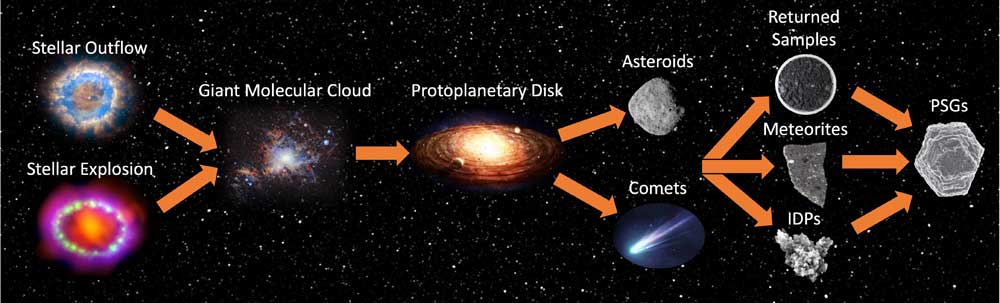
Stardust in Aqueously-altered Meteorites: studying presolar grains in Bennu’s analogue materials

Affiliation: Lunar and Planetary Laboratory, The University of Arizona, 1629 E University Blvd, Tucson, AZ 85721-0092, USA Presolar, or stardust, grains are small (typically nanometers to a few microns in diameter) amorphous or crystalline dust particles that condensed in the outflows of asymptotic giant branch (AGB) stars and supernova explosions that predate the Sun. These grains were a part of […]
Stardust in Aqueously-altered Meteorites: studying presolar grains in Bennu’s analogue materials Read Post »

X-ray Computed tomography for preliminary examination of Mars 2020 cached samples: testing the possible impact of ionizing radiation on Mars-relevant organic compounds.

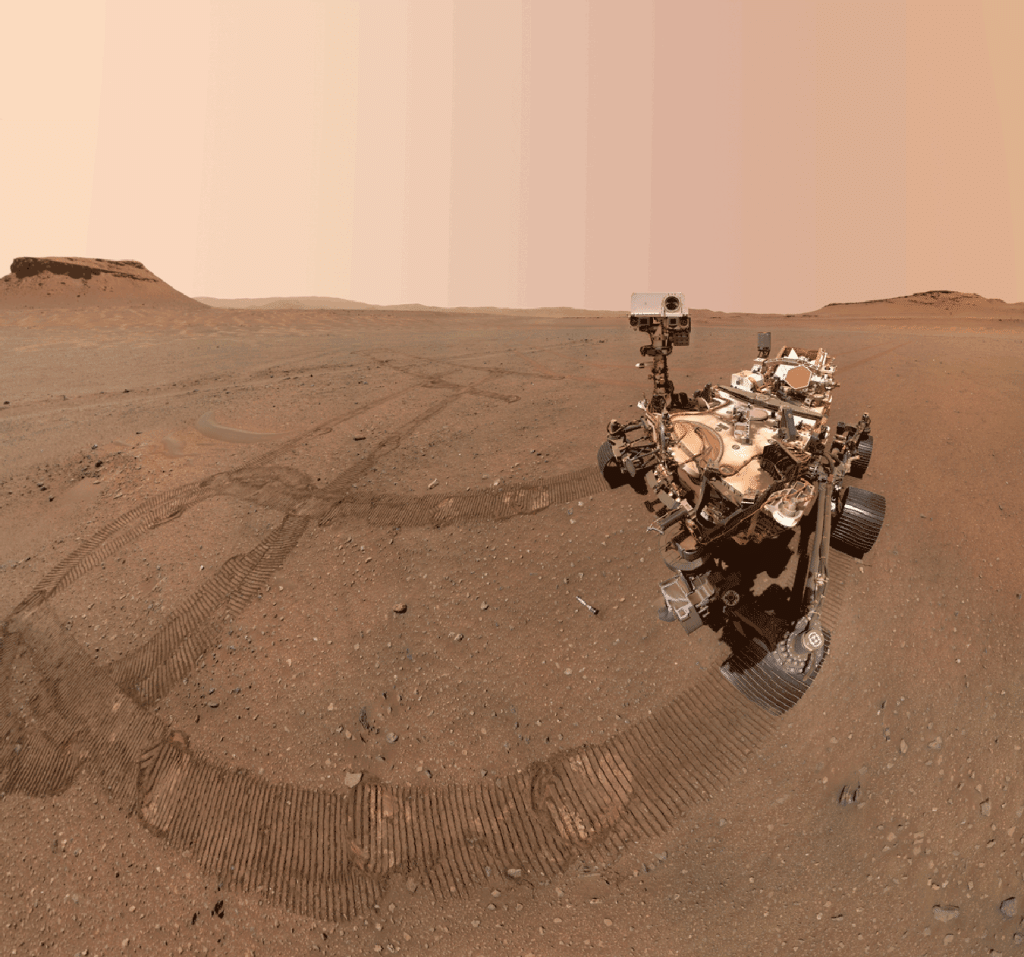
The Mars 2020 rover mission is currently collecting and caching samples from the Martian surface for future retrieval and return to Earth. The return of those samples would present our first opportunity to analyze Mars samples with detailed knowledge of their geologic context. In addition, these samples could contain definitive information about the existence of past or present life on

X-ray Computed tomography for preliminary examination of Mars 2020 cached samples: testing the possible impact of ionizing radiation on Mars-relevant organic compounds. Read Post »

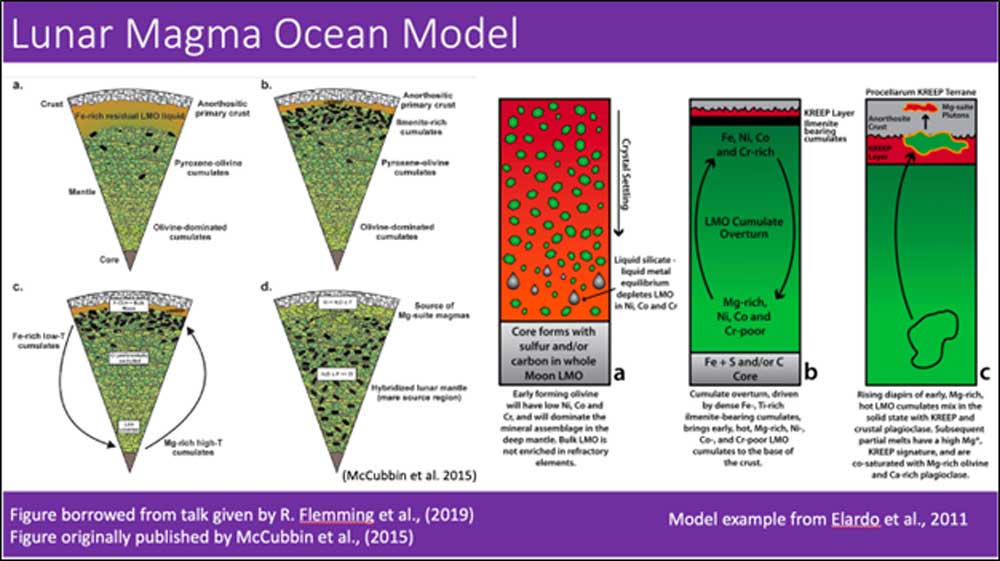
Paradox of the Newfound Lunar Meteorite and the Current Lunar Magma Ocean Model

After over half a century since the last Apollo mission in 1972, the successful launch of the Artemis Mission will bring humans back to the Moon. This exciting new mission carries goals for the latest scientific discovery and economic opportunities for lunar exploration, and it also inspires the next generation of space missions to Mars.     While the new

Paradox of the Newfound Lunar Meteorite and the Current Lunar Magma Ocean Model Read Post »

Nano-scale investigation of troilites from enstatite-rich meteorites: enigmatic witnesses of terrestrial planets formation?

Noemi Mészárosová1,2 1 Institute of Geochemistry, Mineralogy and Mineral Resources, Charles University, Albertov 6, Prague 2, CZ-12843, Czech Republic. 2 Institute of Geology of the Czech Academy of Sciences, Rozvojová 269, Prague 6 – Lysolaje, CZ-16500, Czech Republic. As enstatite-rich meteorites, we (scientists) refer to meteorites from distinct clans, although they share some common characteristics. Enstatite-rich meteorites include enstatite chondrites

Nano-scale investigation of troilites from enstatite-rich meteorites: enigmatic witnesses of terrestrial planets formation? Read Post »

Investigating planetary interiors with meteorites: the case of Mars

Investigating planetary interiors with meteorites: the case of Mars Nicola Mari* *School of Geographical and Earth Sciences, University of Glasgow, UK. The interiors of the terrestrial planets still remain a realm of absolute mystery. The internal compositions and thermodynamics of the terrestrial planets are keys to ultimately understand how they initially formed and evolved in differing planetary systems and can

Investigating planetary interiors with meteorites: the case of Mars Read Post »

Understanding Solar System History: CAIs in Meteorites

Understanding Solar System History: CAIs in Meteorites Emilie T. Dunham* *Center for Meteorite Studies, School of Earth and Space Exploration, Arizona State University, PSF 550 E. Tyler Mall, Tempe, AZ 85287, etdunham@asu.edu One of the most rewarding and exciting parts of studying meteorites is being able to participate in public outreach events. At such events, I enjoy placing a piece

Understanding Solar System History: CAIs in Meteorites Read Post »

Probing the early Solar System at the atomic level.

Mr. Luke Daly1,2 1The Institute for Geoscience Research (TIGeR), Department of Applied Geology, Curtin University, GPO Box U1987, Perth, WA, Australia 2School of Geographical and Earth Sciences, University of Glasgow, Glasgow, G12 8QQ, UK The invention of the light microscope by Hans and Zacharias Jansen 1580-1638 and telescope by Hans Lipperhey in 1608 using two glass lenses revolutionised our understanding

Probing the early Solar System at the atomic level. Read Post »

Understanding the Early Solar System through the Analysis of Meteorites: The Process of Maximizing Data while Minimizing Sample Destruction

Ellen J. Crapster-Pregont1,2 1.Lamont-Doherty Earth Observatory, Columbia University, Palisades, NY, 10964, USA. 2.Dept. of Earth and Planetary Science, American Museum of Natural History, New York, NY, 10024, USA. Every year approximately 40,000 meteorites make it to Earth’s surface. This value is based on camera network meteor data (Halliday et al., 1989; Bland, 2005) and weathering studies of hot desert meteorites

Understanding the Early Solar System through the Analysis of Meteorites: The Process of Maximizing Data while Minimizing Sample Destruction Read Post »

Kamil Crater (Egypt) a natural laboratory to study shock metamorphism and impact melting

Kamil Crater is one of the most recent discovered impact craters. It was incidentally identified in 2008 by Vincenzo De Michele (Italy) during a Google Earth survey while he was searching for ruins of prehistoric settlements in a rocky desert area of the southwestern part of Egypt (22°01’06’’N, 26°05’16’’E; Figure 1). In 2010, an Italian-Egyptian geophysical campaign was organized with

Kamil Crater (Egypt) a natural laboratory to study shock metamorphism and impact melting Read Post »

IMCA Insights – June 2012

The meteorite de Monferre (France) By Jean-Michel Masson Translated by Anne Black Late in the evening probably around 10pm, during the summer of 1923, the inhabitants of the village of Treville in southwest France between Toulouse and Carcassonne observed a large fireball crossing the sky. The bolide was lying from south to north and passed just east of the village.

IMCA Insights – June 2012 Read Post »

Scroll to Top