Micro Visions

Calama 074 Fusion Crust

Calama 074 is a 17 gram oriented ordinary chondrite found in October 2018 by Ilya Kryachko on a limestone plateau 40 km east of the city of Calama, Chile. Calama is in the Atacama desert at 2,260 m elevation. Average annual rainfall quotes differ wildly. Wikipedia gives 5 mm with no citation. Sources say that no rain at all fell

Calama 074 Fusion Crust Read Post »

NWA 5245 R3

Here are some objects we found in the Rumuruti chondrite, NWA 5245 R3. All are in thin section and viewed in cross-polarized light. We like the appearance of barred olivine; it is both ordered and varied. This 2mm diameter barred olivine chondrule with an igneous rim is much larger than usual for an R chondrite.          

NWA 5245 R3 Read Post »

Devitrified Glass

Many chondrules consist of phenocrysts embedded in a glassy mesostasis. Sometimes the interstitial glass will have been annealed to such an extent that it will have become devitrified through solid state diffusion into distinctly crystalline laths. Here we will look at one of each type.                              

Devitrified Glass Read Post »

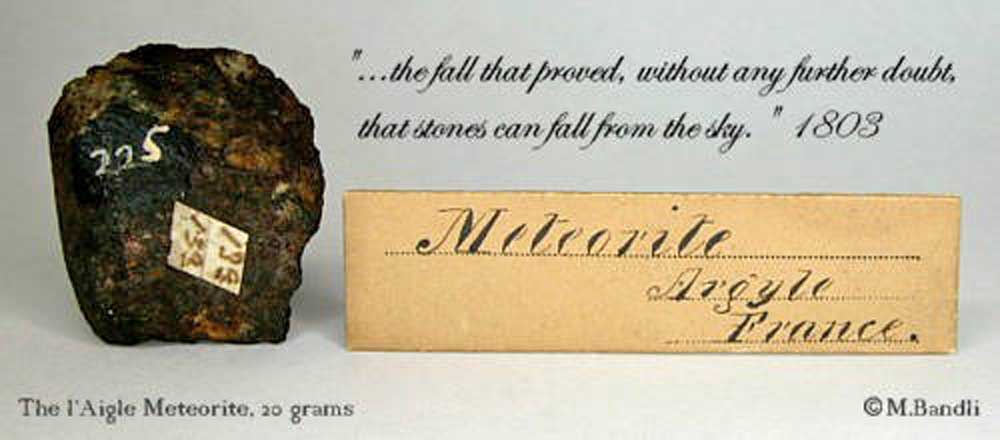
Siena, Wold Cottage, L’Aigle, Soldani, Chladni, Baptiste-Biot, King and Howard contributed to starting Meteoritics

The fall of L’Aigle, in 26 April 1803, is commonly regarded as the event that turned skeptics into believers that stones do fall from the sky; however, Siena which fell almost a decade earlier, on 16 June 1794, set in motion the belief that stones fall from the sky, and the inception of meteoritics.       Historians have often

Siena, Wold Cottage, L’Aigle, Soldani, Chladni, Baptiste-Biot, King and Howard contributed to starting Meteoritics Read Post »

Metal in two CL chondrites

At this writing, September 2022, there are five CL, Loongana group, carbonaceous chondrites. All are of petrologic type 3.9 or 4. Metzler et al. defined the group in 2021. David Weir addresses the subject well on his Coolidge page. CL chondrites contain as much metal as do CR2 chondrites. Here are samples of two CL chondrites showing metal inside chondrules,

Metal in two CL chondrites Read Post »

NWA 13784 CV3-an

NWA 13784 CV3-an was brought to us by Hanno Strufe and Andreas Grünemeyer, described by Ansgar Greshake with oxygen isotopes by Karen Ziegler. It appears to have been affected by both water and shock. Olivine grains are strongly zoned from their centers out. Undulatory extinction is evident in some chondrules. A set of subparallel fractures separate offset blocks. Multilayered chondrules

NWA 13784 CV3-an Read Post »

Symplectites in Nakhla

The Nakhla meteorite fell in the Nile delta the morning of June 28, 1911. Nakhlites are igneous rocks formed in flows or intrusions on Mars. They are rich in augite and contain a portion of olivine, about 10% in the case of Nakhla itself. Olivine grains in Nakhla and other nakhlites contain prominent dark flake-like inclusions. These are very thin

Symplectites in Nakhla Read Post »

D’Orbigny angrite

Alcide d’Orbigny was a French naturalist who explored South America from 1826 to 1833. The 16.55kg meteorite was found near the Argentine settlement that bears his name, about 500 km southwest of Buenos Aires. Angrites are very old achondrites and probably come from a large parent body. They have a wide distribution of cosmic ray exposure ages suggesting that the

D’Orbigny angrite Read Post »

NWA 12692 LL3.00 S3 W2

The 3.00 designation is assigned to chondrites that have experienced the least amount of metamorphism. Few are recognized. In September 2021 there are ten. The two L3.00 are possibly paired. NWA 8576 LL3.00 59.5 g NWA 10061 LL3.00 53.8 g NWA 12692 LL3.00 373 g Semarkona LL3.00 691 g NWA 7731 L3.00 81 g NWA 8276 L3.00 789 g Chwichiya

NWA 12692 LL3.00 S3 W2 Read Post »

Aba Panu L3

The silicates in Aba Panu have been strongly shocked so it is not a particularly pretty meteorite under the microscope in transmitted light, in spite of its being an L3. The Meteoritical Bulletin database says that metal and sulfide occurs as: fined grained spheres in the matrix; armoring chondrules; and, occasional lumps.                

Aba Panu L3 Read Post »

Scroll to Top