
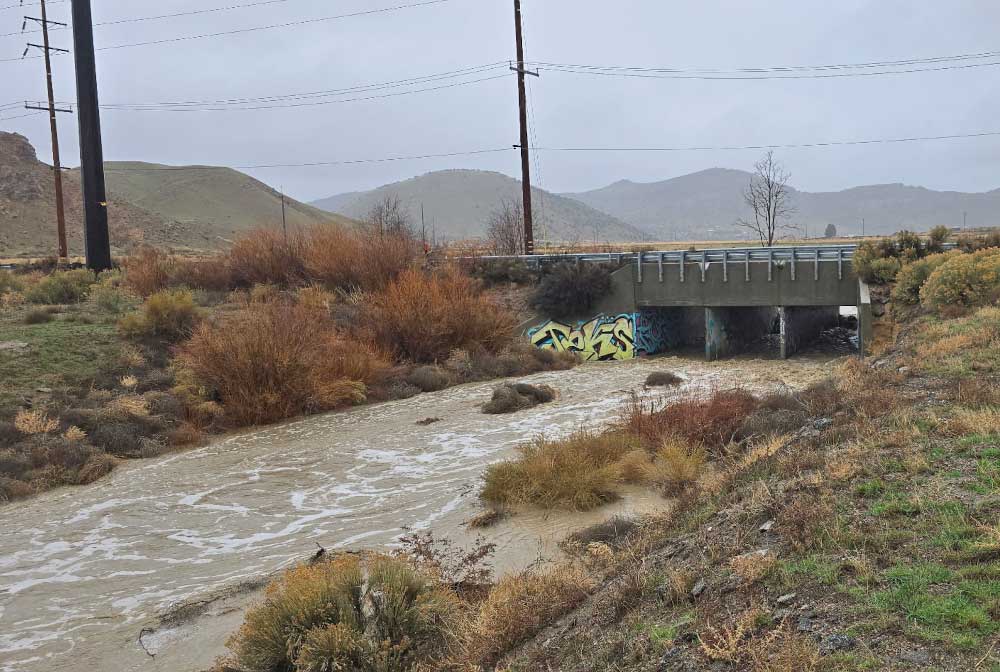
As I sit here gazing out the window at the atmospheric river that is roaring through my mountain town. I am using this dramatic time to write my next article first of a new year. A friend of mine, Mally, who I hike with sometimes took this picture and sent it to me. He hikes rain or shine with his dog. This was one of the washes at the foot of the mountain before the storm got too bad. All around us roads were later washed out and bridges damaged.
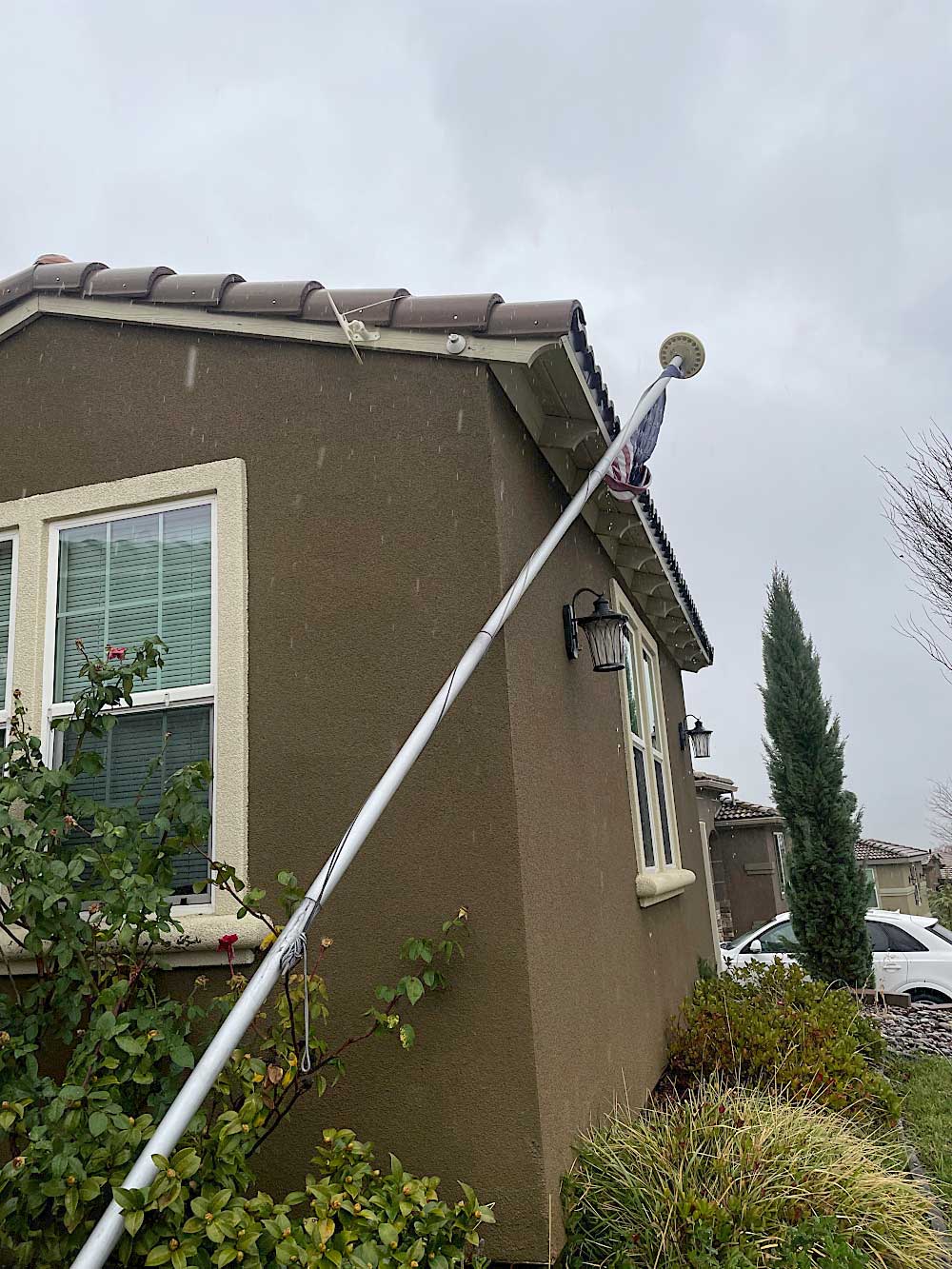
I needed to go out and just mail my bills and get a few things at the grocery store. I stepped outside my door and saw the damage in my front year. My flagpole was snapped off quite cleanly about two feet up from the concrete footing in the ground. Something that I had tried actively to prevent by placing a large diameter PVC pipe inside the flagpole to prevent it from swaying more than a small amount. The PVC pipe was expose and itself bent inside the flagpole which was resting in a large rose bush against my studio building. The security camera was lying at the base of the bushes having been torn from the wall when the flagpole failed. I looked at this and went and did my errands and later found out that heavy things were flying all over town last night. Gusts up to 65 miles an hour were reported in my area. One more day and a half then I can get back to work in the studio/lab. A week of such weather was predicted so I would be inside with plenty of time to work on this article and other inside chores.
A few weeks ago I was not worried about the weather or winds. I had been invited to travel to help instruct at the setting up a lapidary lab for meteorite work. I left home about three in the morning on what I expected would be about a whole day drive with fuel stops and food and restroom breaks. Very long drives get a but dull when you are along in the car. The stops help to freshen my mind and keep me alert. I arrived more or less the time I thought. Work would not start until in the next morning.
I began training with some cutting of unclassified NWA material on the saw that was there. Then lapping and polishing a few slices and endpieces. It was good meteorite material to learn on. But the saw only allowed for clamping the meteorite in the typical rock vise. If one can get the meteorite clamped down hard and solid (not always an easy thing) two or three or four slices at the most can be taken before the meteorite needs to be unclamped and moved exposing more of the stone. You never get the stone back aligned perfectly with those vises. You get a first cut that is slightly wedged with every new clamping in the vise.
With meteorites it is very important that the slices have no wedge. Many collectors enjoy putting their specimens under a microscope to look at or photograph their features. A slice that is wedged will not focus properly and require constant focus adjustments as it is moved around on the stage.
To be productive in a lab you need to completely prepare many slices a day. Often the cuts will all be the same thickness. A few decades ago we cut slices that were just about a quarter of an inch thick. Today most slices are much thinner, often half that thickness. Lunar and Martian meteorites will be cut very thin often less than 2 millimeters.
The saw that was there to be used initially was an old machine that had not been in service for several decades I guessed. I disassembled the saw and washed all the parts in Gunk engine cleaner. There was about an inch and a half of residue in the coolant tank that had turned back into a rocklike material. I painted the parts that I could and reassembled the saw now bright and clean and looking good. It ran smooth and was ready for a few more decades of work. An additional half day was needed in making an adjustable fence adapter so the person operating the saw could make repeated slices of the same thickness. A new thin blade was installed on the saw. It performed well.
There was the beginnings of a nice lab already at the facility. There was a lapping machine with diamond discs of all the essential grits. Polishing discs and diamond compounds. All the discs were 8 inches in diameter, the really useful size. Though I have a 12 inch lap with no center hole at my lab which certainly comes in handy for larger pieces. There were hand grinders, vices and hand tools, containers for finished work and alcohol for washing and soaking the meteorites. Much of what is needed for a well-supplied lab was already present. I was doing a lot of work while teaching also. My days started about 7 in the morning and ended usually around 5 in the evening with only one or two short breaks. But I was enjoying my time, and my instruction was clearly appreciated by the staff who were eager to learn. That made doing the training fun.
After the first days of machine repair and modifications and working with NWA materials the training on stone meteorites was basically done. Some of the subtle things will just have to be learned and treated on an individual basis as the stones come through the lab. Things like which stones to polish bright to a water wet surface and which to leave smooth but unpolished so the details are better seen. I worked on some stones like that while there to show the difference and give the idea of what I was talking about. More meteorites will stream through the lab over time. They will get used to making those decisions.
Iron meteorite material that needed work was the focus for the next several days. There were historic iron meteorites and at least a couple hundred pieces of several different pallasites that needed preparing and etching. There were Canyon Diablos and Gibeon irons and three or four unknown Irons and a few pieces of Toluca all requiring work and etching. We jumped into this work. I taught every step of how to grind, sand, polish, and protect the meteorites until later etching. It was great fun working on the meteorites. I have to admit though that after several days of working with the nickel-iron dust and the chemicals (mostly 99% isopropyl alcohol) my hands were getting very dry, rough, and tired. But the training was going very well.
About a dozen large pieces of pallasites and perhaps a hundred smaller slices needed preparation and etching. Great care needs to be taken when working with pallasites and irons to prevent later problems. Fingerprints and any oil will cause problems later when etching. Keeping pieces very clean and dry is essential.
Quick and dirty preparation to make material available at gem shows like Tucson often results in nearly immediate rusting issues being seen. I know it was hard for me to pass some of this material over the years at gem shows. Some of them are really beautiful and enticing. I eventually learned that it was just better to pay a bit more and buy material prepared by technicians I trusted. If I did it would remain stable and never need repairing. Later I found it was better to just buy the stones and cut and prepare them myself. I have an endpiece of Toluca which I bought at the Tucson show years ago from a famous dealer. He actually mentioned that it had just barely been completed before the show. When I got home four days later it was already terribly rusted. It has been an unstable stone ever since. It stays hidden in the darkness of a vacuum sealed container. If it comes out to play it will be rusted again in days. I have soaked it for weeks in solutions and reground it and etched it and neutralized it in multiple baths only to have it continue to rust. All because of the initial bad treatment it received. My goal during my time at this new lab was to teach best practices. But you still kind of have to hope that over decades the irons will remain fine.
There was plenty of iron material of all kinds to use for training. We worked on fine, medium, and course Octahedrites. There was a little Chinga ataxite material that just needed fine grinding and polishing. It is often better to just leave it polished since it has almost nothing to see when etched. You might see a few fine lines but usually not very much. It has so much nickel in its composition that it is less likely to have problems but keeping chemicals out of cracks is often good. There were slices of pallasites from several different falls to work on. There was a time when nearly all irons and pallasites were left uncoated after they were prepared. Now it is very common to coat them with a gloss spray plastic. It is becoming common now to flood the surface, so it is super shiny and the slices look flawless. This thick coating covers any pits of missing or cracked olivine crystals and hides other issues the slices may have. The results are beautiful when the coating is done but the actual prep work needs to be perfect. Anytime you coat slices they must be properly prepared, neutralized, rinsed and dried to prevent rusting under the coating. We worked on the iron specimens for several days and got them polished. They all soaked in alcohol for about two days with the baths changed at least twice with fresh 99% alcohol.
There was actually so many to polish that we quickly ran out of diamond compound to charge the felt pad on the lapping machine. More supplies were ordered soon after my arrival but with a postal holiday and two weekends it took a longer than normal time for them to arrive. So not having diamond compound in 50k or 100k or even any 14k mesh, I used Zam on the disc. It worked amazingly well yielding a bright polished surface.
Once the iron meteorites were cleaned of rust, ground, and polished it was time for me to teach the etching process.
One of the first thing I did upon arriving to the facility was to discuss the methods of etching and find out which they wanted to use. I told the story of having used nitric acid and alcohol for years but never having been comfortable with the dangers evolved. I told the staff that Ferric Chloride was what I had used for the last couple decades. I told them that the etch was thought by some individuals to be less bright. I said that I could not disagree with that statement but that it was far safer and did make a very nice etch. They had already decided that they did not want to use the nitric acid method since an explosion happened to a friend who used nital. The ferric chloride was not available anywhere nearby. It was ordered but was not going to come for some days.
By the time that we had all the iron meteorite and pallasites ready to etch the ferric chloride had arrived. I set up four baths outside in the fresh air using plastic tubs. One for the ferric chloride, another for a bath of strong baking soda as the first neutralizing station. The third tub was another of baking soda which would get contaminated much slower than the first and stay chemically active much longer. The fourth bath was distilled water though purified water would have been fine too. A large bath of 99% isopropyl alcohol was across the table from the other tanks and was where the meteorite pieces would soak for a few minutes before going inside the lab building and soaking overnight in another tank of alcohol.
After all the tanks were set up and ready to go the demonstration and training began. The entire staff came out to the lab area to watch the magic. I love this part of working with iron meteorites. Each meteorite reacts differently. The pallasites will etch fully in just a few seconds so flipping them back and forth to see both sides of the slices is required and takes a little practice to do right. Mostly flipping without dripping ferric chloride all over it stains so badly. I did a few so they could all see the process. Then I did a few octahedrites, each of those requiring much longer etching times. All meteorites were carefully keep in batches with only others of their own kind, I had pressed throughout my instruction the importance of never allowing for the possibility of mixing any meteorite material with any other meteorite types in the lab.
After etching several pieces of some different types of irons and pallasites I relinquished the chair to the lab manager, who would etch all the rest over the next few days. He saw how the first neutralizer bath got contaminated very fast and needed to be changed often. He observed how the second one would also need to be changed though less frequently. He learned to change the water frequently and the alcohol baths occasionally.
The coating of some of the metal meteorites mostly the pallasite slices with gloss urethane was done on a few pieces before I left to return home. The method will be perfected using a real spray booth better than what I had quickly put together. The pallasites looked so beautiful and the etch on the irons was very nice. I was to leave in the morning the next day to drive the long trip home. I felt really good about the training. It also felt good that there was now another group able to do this meteorite cleaning, cutting, and preparing work in the meteorite community. I felt honored to have been asked to go and do this. They can expand in the future with more equipment, and their staff will gain experience and get faster.
I thought about the two weeks during my trip home. My hands were a constant reminder. The plastic gloves had both torn and ferric chloride had gotten in and stained and dried out my hands. They were now much rougher and irritated. It would be a month or more before the last of the orange stain was gone from my skin and nails. I made a stop to visit my cousin for a few hours. He was less than an hour out of my way. We had a nice meal and talked. We chat on the phone every few days, but I had not seen him in years.
I got on the road to head home early in the morning, planning again for a very long trip that I might have to break into two days depending on how long my visit was with my cousin. It was a full day of driving, and the last hundred miles when I might have been tired was a nightmare that kept me hyperalert. I don’t know what I might have done to anger this individual, but he was clearly deranged also. He road my bumper for over a hundred miles. He pulled around me one time to get a look at me through my passenger window then pulled back onto my bumper. He was so close I could see the blurry reflection of my license plate in my rear view camera reflecting off the front of his car. I could not get to my phone or do anything except drive perfectly so he would not hit me. When I got really close to home in the very early hours, I knew I needed to lose him or drive to the police station in town. So I waited until there was a tractor trailer rig next to me and I suddenly accelerated and swerved in front of the semi. I left no room for the crazy man to get back behind me. The traffic behind him forced him to pass me. I watched his taillights carefully to make sure he was ahead and disappearing in the distance. I got off as soon as I could and drove the last six mile or so home. It was a very stressful ending of a quite remarkable and enjoyable 14 days of doing work with meteorites. The kind of experience that I may never have again. I never worked on so many irons and pallasites at one time in my life.
I am sorry a bit for the lack of images in the article. I did not want to take and print pictures of someone else’s facility.
