I figured I would flip the script for this entry in the series and talk about the man before talking about the mineral. The Field Museum of Chicago is well known for having a world-renowned collection of meteorites. That distinction is due to the early work of Oliver C. Farrington who joint the museum in 1893 at its founding and was the first curator of geology till his death in 1933. Farrington oversaw the growth of the meteorite collection from an initial 170 specimens bought by Marshall Field from Ward’s Natural Science Establishment on display at the 1893 World’s Columbian Exposition. By the time of his passing Oliver had grown the collection to over six hundred named locations, which amounted to more than half of all known meteorites at the time, a testament to the collection’s prestige and importance to science. Farrington did more than just grow the Field Museum’s collection. Farrington taught at various Maine academies early in his career spreading his expertise in minerology and continued educating as lectern on minerology at University of Chicago from 1894 to 1904. He published prolifically during the middle of his career to include Meteorite Studies-1 (1902), -II (1907) and -III (1910), Analysis of Meteorites (1907) and Analysis of Stone Meteorites (1911) and finally in 1915 he published the foundational book Meteorites-Their Structure, Composition and Terrestrial Relations. He was also recognized for his curation work and functioned as president of the American Association of Museums from 1914 to 1916.
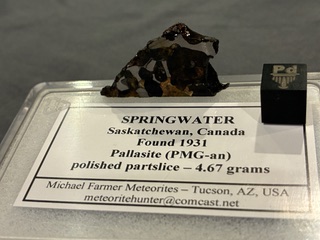
The Springwater meteorite was found by a farmer clearing a field in Saskatchewan Canada in 1931. That gives it the honor of being the first pallasite meteorite found in Canada. The original find consisted of three recorded masses weighing 38.6 kg, 18.6 kg, and 10.6 kg. It is said that a 4th large mass was given the Elbogen treatment and was thrown down a well, in this particular case never to be recovered. Harvey Nininger caught word of the find and subsequently bought the three remaining masses. Nininger cut the masses and distributed the material to many major institutions including the Field Museum of Chicago. As if being Canada’s first pallasite, the well incident, and passing through the hands of the worlds first professional meteorite hunter wasn’t enough cool factor, 78 years after its initial finding, researching of the strewnfield turned up a new main mass. Much of Nininger’s meteorite related information ended up archived at Arizona State University. Within those files was a hand drawn map of the Springwater strewnfield, this little tidbit of ephemera from the 1931 find lead Michael Farmer and a team of meteorite hunters to investigate if there was more material left unfound. The results of that expedition were the recovery of additional pieces totaling over 100 kg of additionally recovered material, including the new main mass of 52 kg, which is prominently displayed at the Royal Ontario Museum.
Farringtonite belongs to the phosphate mineral group and has a formula of Mg3(PO4)2. It is described as being variable in clarity from transparent to translucent, with color ranging from colorless to white through pale yellow into the amber yellow color spectrum. It displays distinct good cleavage and is monoclinic in crystal structure. Farringtonite is the low pressure-high temperature dimorph of Chopinite. The Handbook of minerology states it occurs as a rare component of pallasite meteorites where it is found rimming and cementing olivine nodules. While Chopinite is a mineral which occurs on earth in rare instances in deep-crust metamorphic rocks, Farringtonite is one of the interesting minerals that has no natural earthy localities. Farringtonite was named to honor Oliver Cumming Farrington in 1961 when it was discovered by E.R. DuFresne and Sharat K. Roy and was formally published in the Geochimica et Cosmochimica Acta, Volume 24 Issue 3 in July of 1961.
I love hunting down type locality specimens, though I will be honest, most are usually visually underwhelming when it comes to being able to discern the mineral they are famous for containing. The specimen I picked up tickled my fancy as it was definitely the exception to this norm. It also had an extremely short provenance chain which I always consider a bonus. In this case the chain was finder to me. Last year while Michael Farmer was posting photos from a show I figured it would be a suitable time to inquire if any Springwater was available. Turns out asking was the right move, he not only had a part slice that was in the sweet spot of size and price range for me, but the message that accompanied the photo sent over for review said “You see the really nice Farringtonite on the Springwater [?],. Quite rare”. At just over 4 grams my piece has not one but two nice Farringtonite inclusions.